WHAT IS A PARAMEDIC
‘A paramedic works autonomously as a generalist clinician across a range of healthcare settings, usually in emergency, primary or urgent care. They may also specialise in clinical practice, education, leadership or research.’ The College of Paramedics (2019)'
The Royal College of Paramedics defines a paramedic at the point of registration as: An independent, graduate-level, generalist clinician commencing a journey of lifelong learning. Approaching their patients holistically, they draw on a range of systems-based assessments, diagnostic tools, and interventional skills; and are able to manage an undifferentiated, diverse, and complex case load of patients, including the critically ill and injured, doing so in environments over which they have limited control. They advocate for their patients, stratifying risk and navigating changeable health and care systems to implement appropriate person-centred management plans autonomously, and as part of a multidisciplinary team. They support and supervise colleagues, as well as seek advice and support when needed. They exhibit professional values, attributes, skills and knowledge across the four domains of practice that are underpinned by ethical reasoning, research and evidence. (College of Paramedics 2024)
Paramedics are registered healthcare professionals who have a unique role that crosses healthcare, public health, social care and public safety, they work autonomously providing care in a range of situations. Most well-known for working within Ambulance Services providing immediate and emergency care in response to 999 calls made by the public, paramedics now also work in other areas of healthcare, for example GP practices, hospital emergency departments and police custody suites.
Paramedics are one of 14 Allied Health Professionals (AHPs), to learn more about AHPs and to take a behind the scenes look at the wide variety of careers available as an AHP, watch this 20 minute ‘The Wow Show’ film here.
AMBULANCE SERVICE PARAMEDIC
Anyone who’s watched a TV hospital drama will have an idea about what a paramedic does. And while it’s not all sirens, blue flashing lights and high-speed driving, it’s still an exciting career choice! Paramedics are the senior clinician on an Ambulance or sometimes work alone in an Ambulance Service rapid response car. Based at a local ambulance station or central ambulance hub, ambulance paramedics work shifts, including throughout the night and weekends, working in any weather and at all hours of the night or day, 365 days a year. Paramedics have advanced driving skills that allow them to claim exemptions from certain road traffic legislation whilst driving to the location of a 999 call made by the public.
Paramedics are educated and trained to make decisions in complex and high-pressure situations in unfamiliar and often unpredictable environments. Paramedics are skilled at history taking, consultation skills and examination, judgement in diagnosis and management of a wide range of illness and injury from new-borns and babies to the elderly and those at the end of their life. Paramedics have expertise in dealing with critically ill and injured patients using complex equipment and a range of medications whilst getting the patient to the right hospital for their ongoing treatment. Paramedics also work closely with other healthcare teams, such as: GPs, Nurses, Mental Health Crisis Teams and Pharmacists to manage patients in the community or closer to their home.
As well as contact with the patient and other healthcare colleagues, paramedics also deal with a patient’s relatives and friends and members of the public, some of whom might be highly distressed or upset. The ambulance paramedic often works alongside colleagues from the police, fire and rescue services and the coastguard.
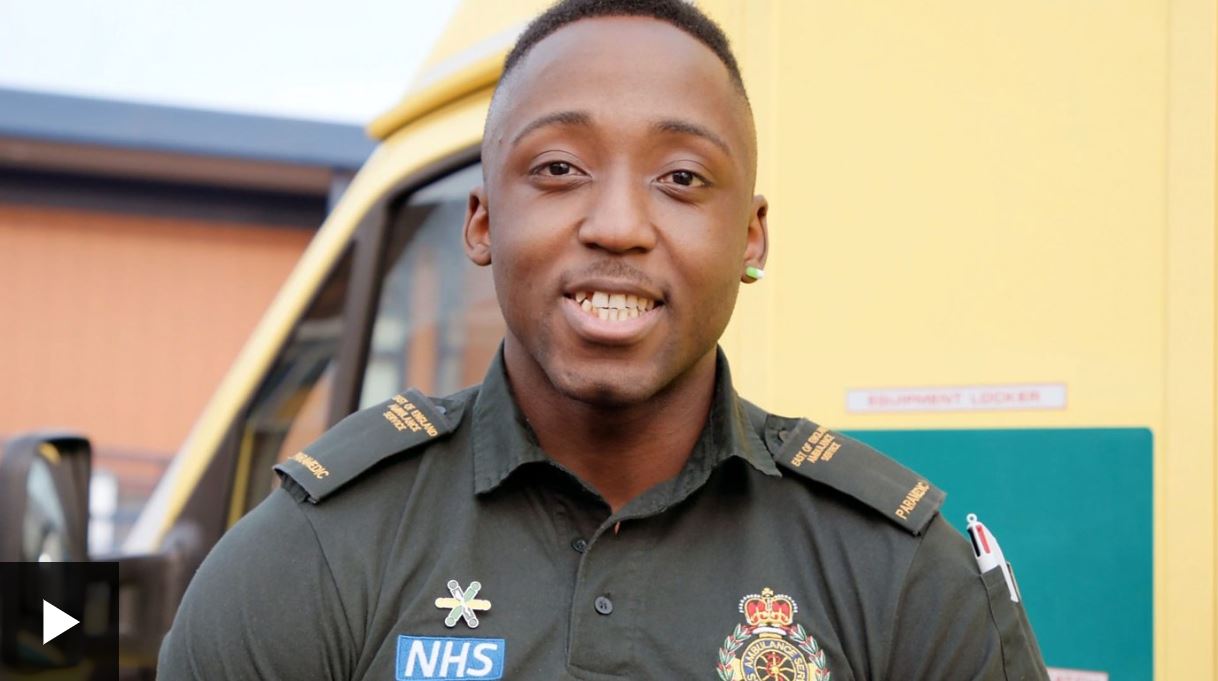
Watch here for Tanoh's story about what its like to be a paramedic.
NOT ALL PARAMEDICS WEAR GREEN
In recent years the paramedic profession has evolved from being a provider of emergency treatment and transportation in an ambulance to a provider of mobile healthcare. As a result of this evolution, paramedics can now be found working in multiple settings including general practice, minor injury units, urgent care centres, walk-in centres and accident and emergency (A&E) departments, telehealth and telecare services and in remote and offshore sectors. Paramedics in some of these settings often undertake advanced clinical assessments and take the responsibility for the ongoing care provided to patients, in addition to onward referral and discharge.

HOW TO BECOME A PARAMEDIC
To practice as, and call yourself a paramedic, you must be registered with the Health and Care Professions Council (HCPC). To register with the HCPC, you first need to successfully complete an approved qualification in paramedic science.
There are different routes to studying and qualifying as a paramedic. You can:
- take a full-time approved qualification in paramedic science (e.g. at a university) and then apply to an ambulance service for a job as a qualified paramedic
- apply for a role as a student paramedic with an ambulance service and study while you work
- apply for a degree standard apprenticeship in paramedic science with an ambulance service
Becoming a paramedic takes between two and four years. The course includes a mixture of theory and practical work including placements with ambulance services and other healthcare settings. Each University or Ambulance Service sets its own entry requirements, so it’s important to check carefully what you will need. A full list of current approved Universities offering programmes that lead to a paramedic qualification and registration can be found on the HCPC website.
NHS HEALTH CAREERS WEBSITE
Further information about being a paramedic can be found here…
ROUTES INTO ALLIED HEALTH PROFESSIONS CAREERS WITH THE UNIVERSE OF OPPORTUNITIES
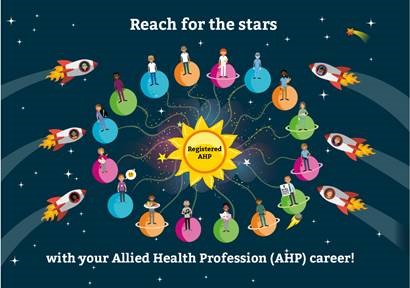
Reach for the stars with lots of information about a range of healthcare careers. This resource provides stepping stones for everyone considering an AHP career no matter what the starting point is. It provides information for people exploring AHP careers or those supporting them. More...
CAREER CHANGE TO AN AHP
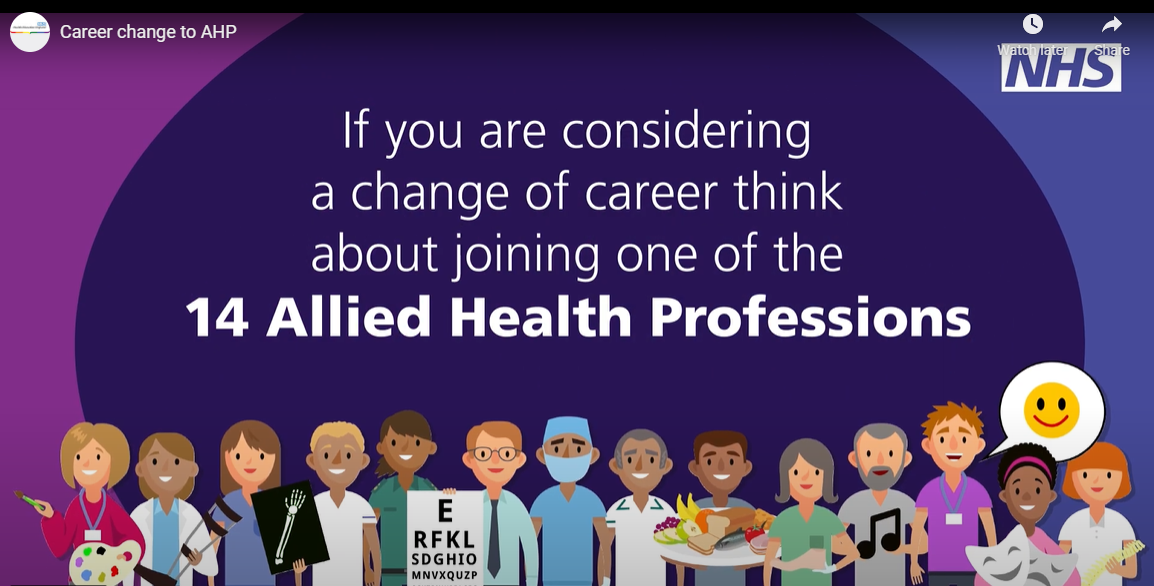
If you are considering a change of career think about joining one of the 14 Allied Health Professions (AHPs). You might think that to become an AHP you have to plan that career from a young age, but many people make a change mid-career. See examples of AHP career changers here.
LISTEN TO WHAT IT’S LIKE BEING A PARAMEDIC
This wide ranging conversation with Lewis explores why he became a paramedic, what he enjoys most about the job as well as the challenges, and of course, he describes how his work life has been during the pandemic.
Click here to listen.